The Church of the Finding of the Holy Cross in Grodno: a Bernardine church four minutes from Gosteam
From Gosteam at 31 Mostovaya Street to the Church of the Finding of the Holy Cross it is about 250 metres. Why go in, and how to continue the walk through the centre from there.
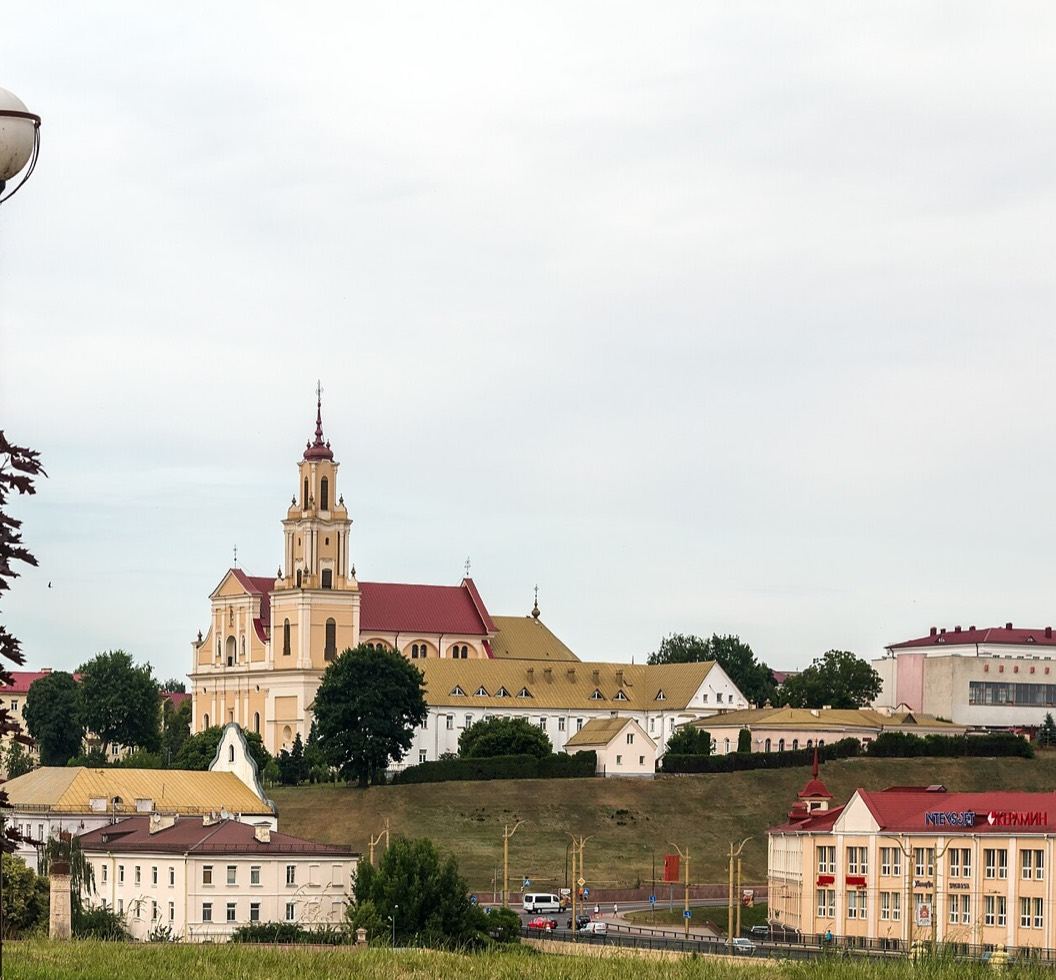
Church of the Finding of the Holy Cross on the high bank of the Neman. 1 Parizhskoy Kommuny Street — about 250 metres from Gosteam. Photo: Mike1979 Russia, CC BY-SA 3.0, Wikimedia Commons
Visitors come to Grodno for the castles, the Farny Church and Sovetskaya Street. That list is right — and almost always incomplete.
Closer to the Neman, on the high bank, stands the Church of the Finding of the Holy Cross — the Bernardine church, not a copy of the Farny. Gothic in the sanctuary, Renaissance and Baroque in the façade, Vilnius Baroque in the bell tower. It is a working parish, not a museum mock-up.
From Gosteam at 31 Mostovaya Street to 1 Parizhskoy Kommuny Street it is about 250 metres. Three or four minutes on foot.
A neighbour on the Neman, not “another church in a different district”
The Farny Church stands on Sovetskaya Square. The Bernardine church stands on the rise above the river. Both are in the historic centre, but they are different hills and different stories. It is easy to mix them up if you only look at a card that says “Grodno church”.
For a guest that changes the day. You do not have to “plan a church for the afternoon” and hunt for a taxi. You leave the hostel, walk up toward the bank — and you already see the tower.
Older than the guidebooks
A wooden Bernardine monastery was founded in 1494 on land given to the order by Alexander Jagiellon. The stone church was begun under Sigismund III Vasa: the cornerstone of the altar in 1602, consecration on 13 May 1618.
In 1656 a fire badly damaged the church and monastery. They were rebuilt, chapels were added, altars changed. The four-tier bell tower, set between the church and the residential wings, is already the eighteenth century, Vilnius Baroque: a figured silhouette, a spire, a separate entrance.
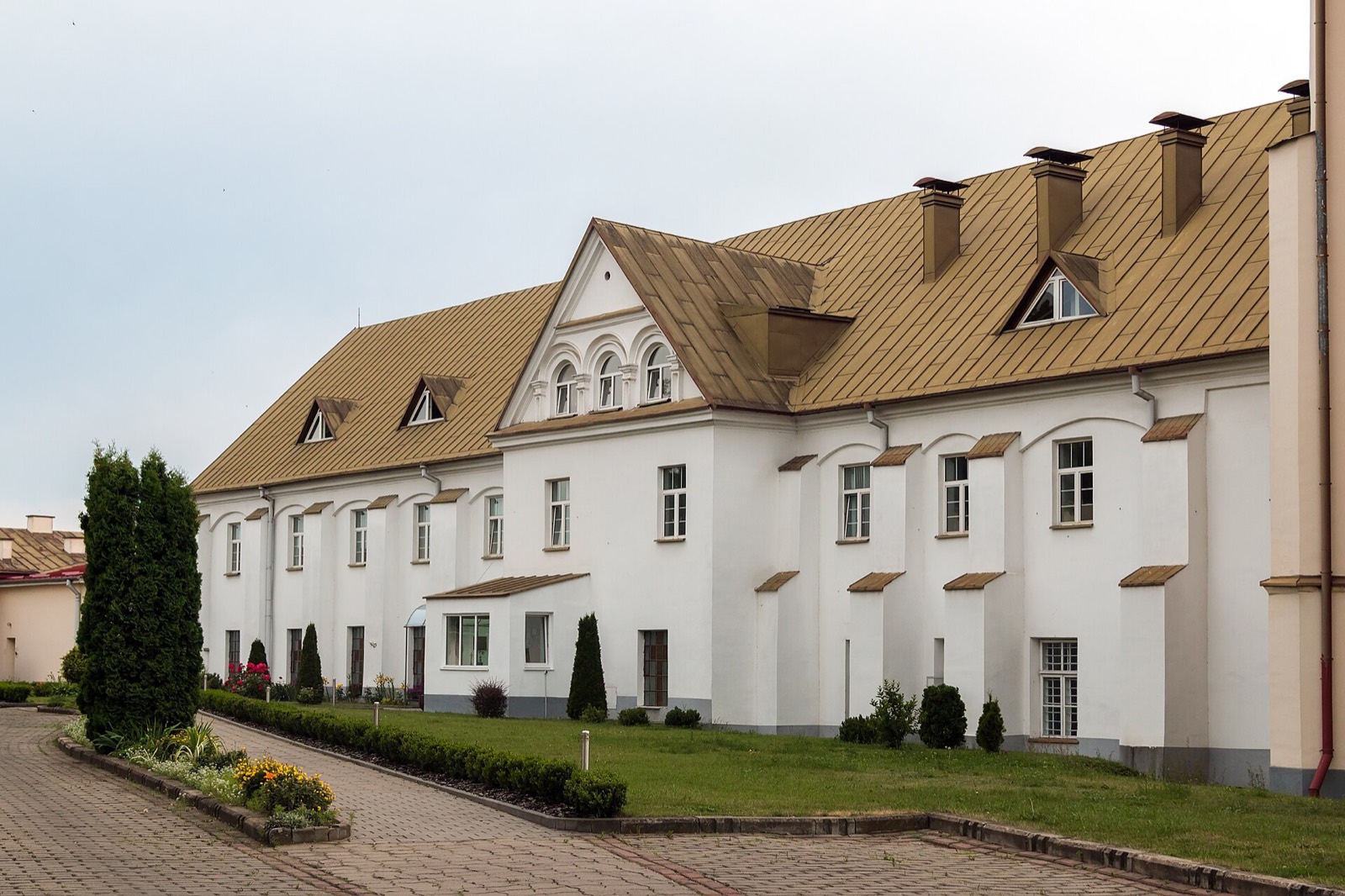
In 1863 the monastery was suppressed and the church became a parish church. In the Soviet years the wings held offices far from prayer. Since 1990 a Roman Catholic seminary has been here: the complex lives again, instead of waiting for a tour bus.
On 21 January 1858Eliza Orzeszkowa was married in this church. For a visitor that is not a Wikipedia aside: it is a church in which the city kept living while governments and shop signs on the next streets changed.
What to look at — even from the street
From the Neman the ensemble reads at once: the tower, the red roof, the white monastery wings on the rise. It is one of the landmarks of the centre — you do not need a ticket to see the scale.
The sanctuary is the oldest part: a semicircular apse, buttresses, pointed windows — Gothic. The main façade is already early Baroque: pilasters, niches, a curved upper silhouette. Inside, if you go in, there is carving, stucco, frescoes, the Loreto chapel. But the façade and the tower are already worth the stop.
The former monastery wings. Since 1990 they house a seminary — a living complex, not a backdrop. Photo: Mike1979 Russia, CC BY-SA 3.0, Wikimedia Commons.
How to go in without fuss
This is a working church, not a viewing platform. Dress modestly, keep your voice down, do not take photos during Mass. Services are often in Polish: it is a living parish, not “for tourists”.
Do not wander the cloister as if it were a museum — there is a seminary there. The church and the tower read clearly from the street and from the slope down to the Neman.
Check the Mass times on the Grodno diocese site grodnensis.by or on the spot.
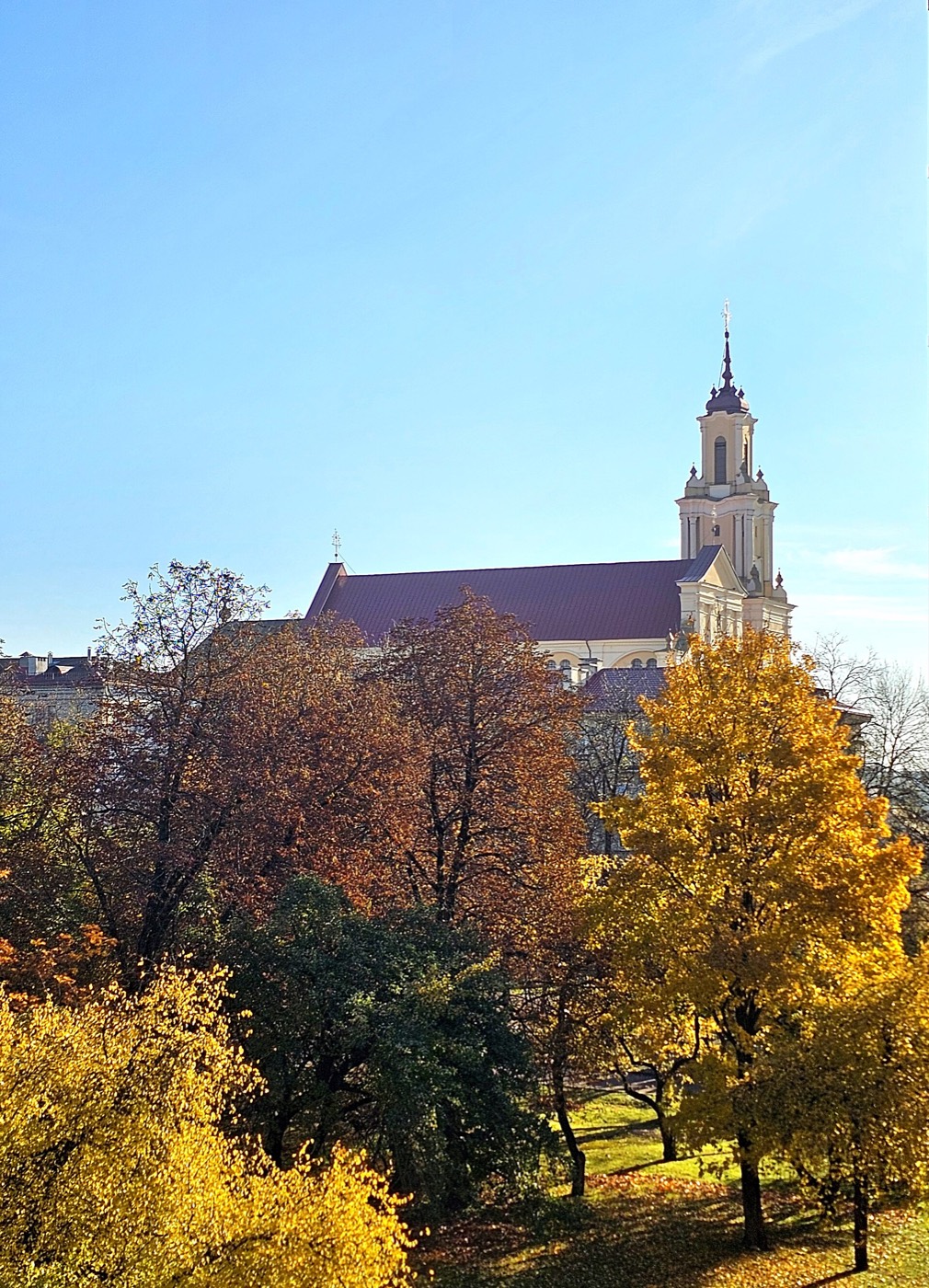
The same walk in another season: leave Gosteam — and a few minutes later the tower is already in the frame. Photo: Dina Panayotis, CC BY-SA 4.0, Wikimedia Commons.
What to see next — without going “back into town”
After the Bernardine church you do not need a taxi. You are already in the Grodno you came for.
The theatre is on the same Mostovaya Street. The convent is two or three minutes the other way. If you want the Farny Church and the pharmacy-museum, walk to Sovetskaya: that is five or six minutes, still on foot.
That is how the centre works if you live in it instead of commuting in for a tour: Gothic and Baroque above the Neman, the Soviet modernism of the theatre, the convent’s domes, the Farny Church around the corner — no transfers.
Why this works from Gosteam
Grodno has plenty of rooms “not far from the centre”. The rare thing is to wake up so that the Bernardine church, the theatre and the convent are a walking habit, not a pin in a maps app.
You can leave the car on the closed car park and not touch it until you leave town. Families do not have to choose between “making Mass” and “taking the children across the whole city”. Anyone travelling alone steps into the street and immediately sees why Grodno is a walking city.
About 250 metres. Three or four minutes. That is not a slogan. It is the route from reception to the tower above the Neman.