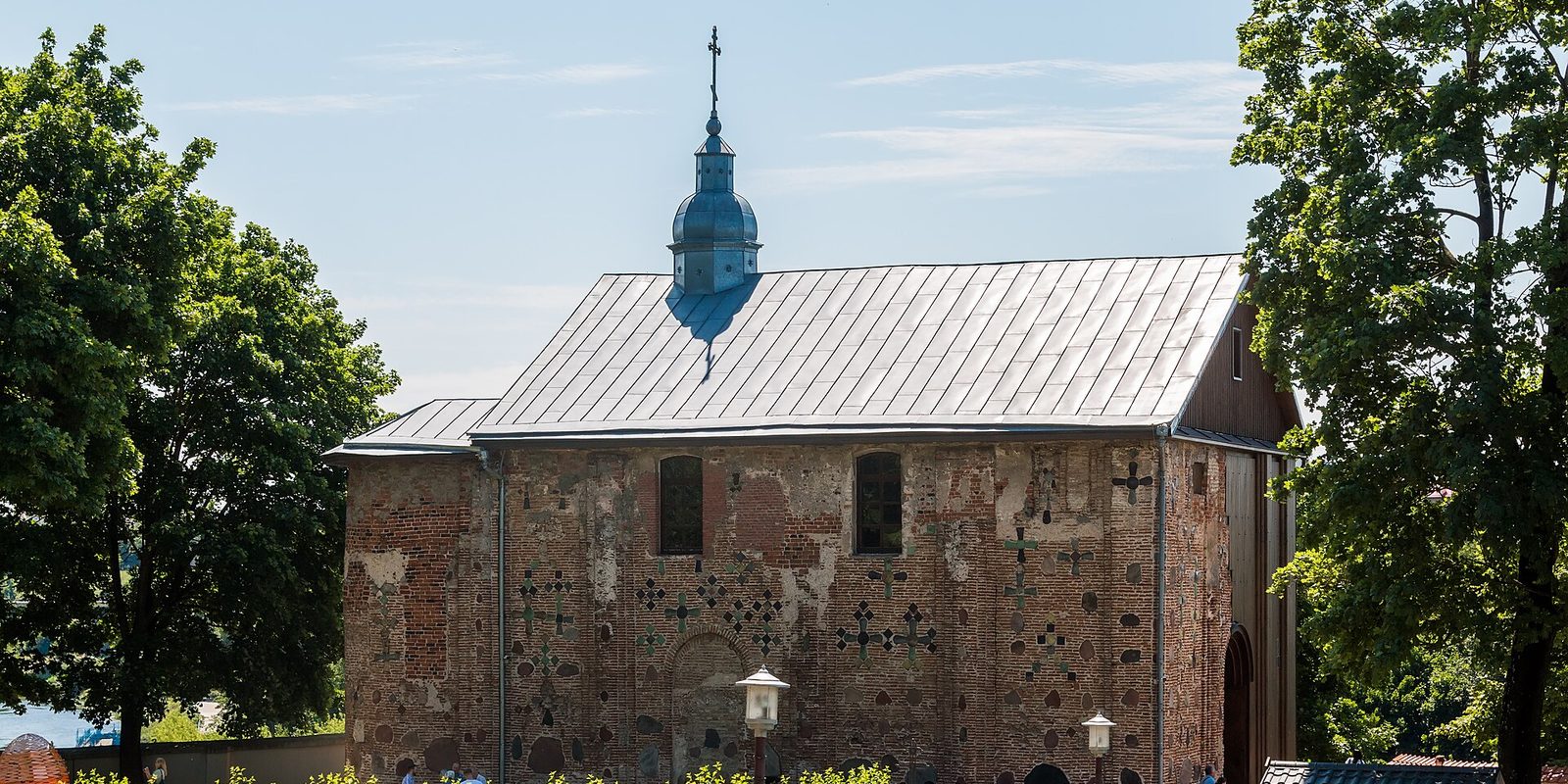
On the night of 2 April 1853 the south wall of the church at Kalozha, together with half of the west wall and the ceiling, fell into the Neman. The church itself remained standing. It stands today on the edge of the same cliff, and where the lost wall used to be it has timber.
This is the Church of Saints Boris and Gleb, which Grodno simply calls Kalozha. It is more than eight centuries old and is counted as the westernmost surviving church of Old Rus.
From Gosteam at 31 Mostovaya Street to Kalozha is about a kilometre and a half. That is not next door: allow roughly twenty minutes. On the other hand you can choose the Neman embankment or the old Bolshaya Troitskaya Street through the park, and both roads are good in their own right.
A church in an open field
When it was built in the twelfth century this was almost empty ground. The church stood far outside the town of the day, on the high bank of the river, and most likely was a monastery church from the start. The exact date is unknown. According to one version it was raised under the Grodno princes Boris and Gleb Vsevolodkovich and consecrated in honour of their heavenly patrons. According to another it was built in the 1180s by their children.
In 1184 the cathedral church of old Grodno burned down in a great fire, and Kalozha became the city’s main church.
The name is a puzzle too. Some historians derive it from kolozhan, a word for a place where many springs rise. Others think it came with the people of the Pskov fortress of Kolozha, whom Grand Duke Vytautas took captive in 1406 and settled near the church.
Brick with a fish on it, and stones of every colour
Kalozha is built of plinfa, thin fired brick. Some of the bricks still carry the stamps of their makers: fish, keys, stars. The walls are double, the outer one about 1.2 metres thick, with a narrow corridor between the two layers. Polished boulders of red, brown, crimson, grey-green and olive were set into the masonry, with crosses of glazed majolica between them. The roof and domes were also covered in coloured glazed tile.
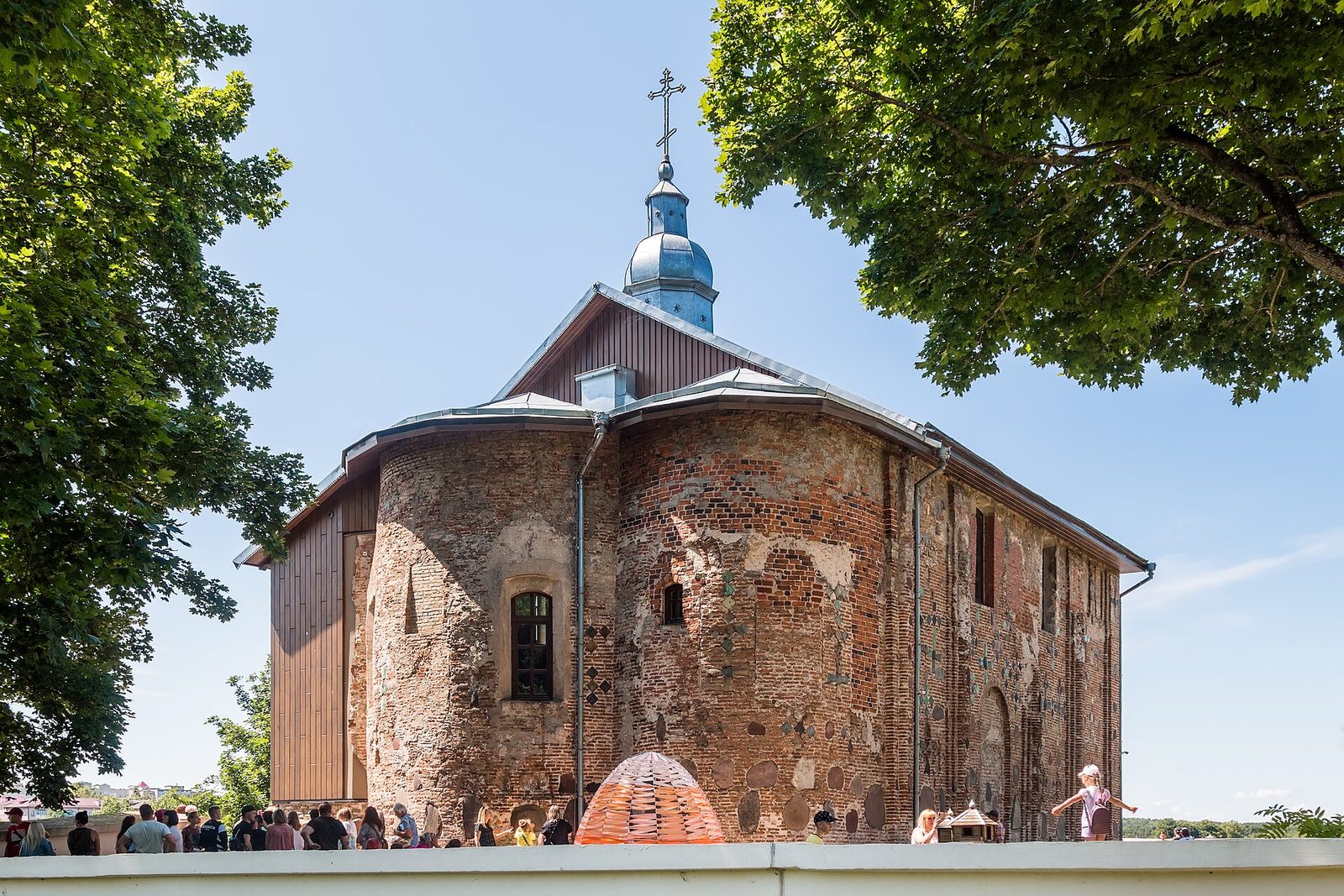
The apses of Kalozha church: plinfa and polished boulders in the wall. Photo: Mike1979 Russia, CC BY-SA 3.0, Wikimedia Commons.
The church has an acoustic secret as well. Clay jugs were built into the inner layer of the walls with their necks turned towards the outer face. They lightened the wall and gave the interior a particular resonance, and the acoustics are good to this day. Ignacy Kulczyński, archimandrite of the Kalozha monastery, described them in the Inventory published in 1748: “many openings that seem small and narrow, because only a hand can be put into them, but inside the walls they widen into large and broad pots”.
The dimensions are modest: 21.75 by 13.25 metres, with the surviving walls rising about nine metres. But the Grodno builders of the twelfth century had a school of their own. Four more Orthodox churches stood near Kalozha in the same style, and according to one version a single master built them, Piotr Milonieg. Of all of them Kalozha survived best.
Century after century
The church was given little peace. In 1241 it was wrecked in the attack of Khan Koidan, and from 1284 the crusaders marched on Grodno; the first raid, led by Master Konrad von Thierberg, did it serious harm. The Grodno castellan David of Grodno never lost a battle to the crusaders, and legend says his druzhina carried his body on their shields and buried it by the church of Boris and Gleb.
In the spring of 1410 the Grodno banner and others from the Grand Duchy of Lithuania gathered by Kalozha. From here they set out west, towards the field of Grunwald.
In the sixteenth century the monastery held the “queens’ garden at Kolozhany”, where, the chroniclers say, Queen Bona Sforza liked to walk. The monastery also ran an almshouse and an icon-painting school.
Then came hard times. During the Northern War of 1655–1660 the city passed from Poles to Muscovite troops to Swedes and back, and each time the church was plundered. By the end of the seventeenth century the monastery was nicknamed “the desert”: the church stood without doors or windows and, according to the records, served as a lair for cattle in summer.
The bank that wanted the church
The slope proved worse than the wars. The church was put on a sandy cliff, and as early as 1720 the bank, undercut by the river, came right up to the walls and the walls leaned. Ignacy Kulczyński, who headed the monastery in 1736–1747, wrote in his Inventory that the site had been chosen very badly. They tried to hold the slope with a fence at the foot of the hill, manure and trees.
On the night of 2 April 1853 the cliff took the south wall and half of the west one. More landslides followed in 1864 and 1889, when the apse of the diaconicon fell. The church was propped up with piles, and in the repairs of 1870 ancient frescoes were found under the plaster in the conches. Scientific conservation ran from 1896 to 1906: the bank was secured, a gabled roof was put over the church, and the missing walls were built in timber. So the church reached the twentieth century, stone in one part and wooden in another.
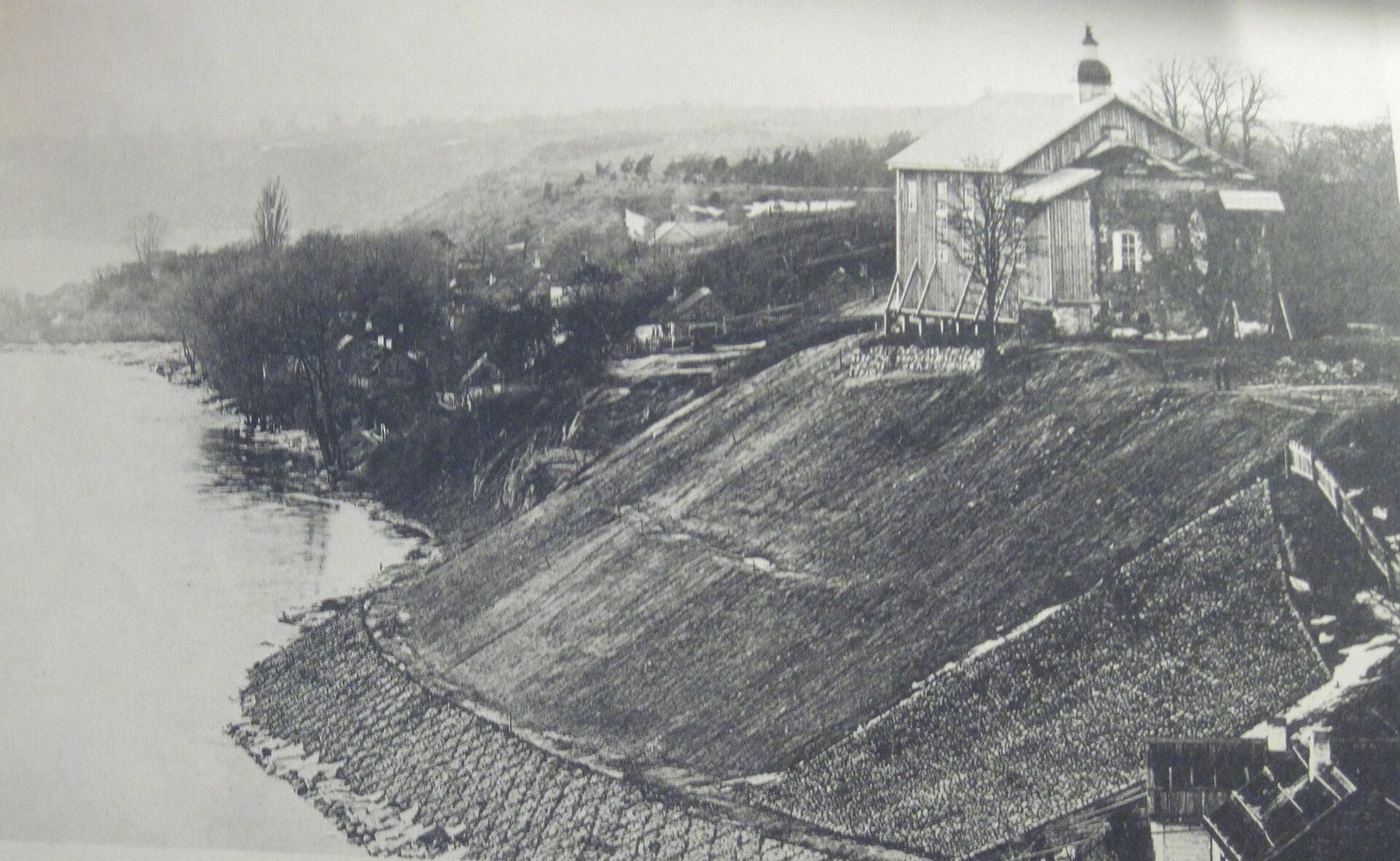
Kalozha church in 1897, seen from the Old Castle side. A timber wall where the stone one fell, and a reinforced slope. Photograph from the book by Bishop Joseph, public domain, Wikimedia Commons.
The twentieth century and the return
In 1914 Emperor Nicholas II prayed with his wife and two daughters before the wonder-working Kalozha icon of the Mother of God. In 1915, before the German advance, the icon was taken to Moscow and lost; only copies remained.
In the twentieth century the church twice became a museum: first a historical one, then a museum of atheism. In 1991 it was returned to the Orthodox Church, and the oak iconostasis was restored with a donation from Uladzimir Mulyavin, leader of the band Pesnyary.
The slope settled again in 2000–2005 and was secured with piles along Rybatskaya Street and a retaining wall. In 2017–2019 the church was restored: in place of the worn timber wall a new one of heat-treated pine was built, drainage was laid, and sensors for temperature and humidity were installed. During the work a fingerprint of an ancient builder was found on one brick, and a glass window appeared in the floor through which the base of the old column can be seen. In 2019 Kalozha was added to UNESCO’s tentative list.
Today it is a working Orthodox church.
How to walk there from Gosteam
There are two roads, and both take about twenty minutes at an easy pace.
The first, along Bolshaya Troitskaya. One of the oldest streets in the city, it took shape between the fifteenth and nineteenth centuries. It leads past the Great Choral Synagogue, built in 1902–1905 in an eclectic style with Moorish touches. The synagogue is still in use. Further on the road goes through Kolozha Park, and the silhouette of the church appears between the trees.
The second, along the embankment. You go down to the Neman and follow the water, while the church waits on the high bank. You will have to climb to it up the slope, the very cliff that tried so many times to bring it down.
If you would like a loop, go there along Bolshaya Troitskaya and come back along the embankment and past the castles:
Gosteam → Bolshaya Troitskaya → synagogue → Kolozha Park → Kalozha → Neman embankment → Old Castle → fire tower → back to Gosteam
If you time it to reach the fire tower by 11:58, the loop ends with the trumpeter’s fanfare.
Kalozha stands on Kalozha Street. Entry is free, but it is a working church: dress modestly and keep quiet during a service. Twenty to forty minutes is usually enough to look around.
Why this is easy from Gosteam
A kilometre and a half each way is as good as the return is pleasant. After Kalozha, the cliff and the wind off the Neman, a shared kitchen is waiting at Gosteam: put the kettle on, warm up lunch and do not hunt for a café with opening hours.
You can leave the car in the closed car park. To Kalozha, the castles and the Farny Church you would be walking anyway, and a steering wheel would only get in the way. For a family with children it helps to be able to come back for a quiet hour and go out again. Anyone travelling alone can walk to the river in the morning and still reach other places before evening.
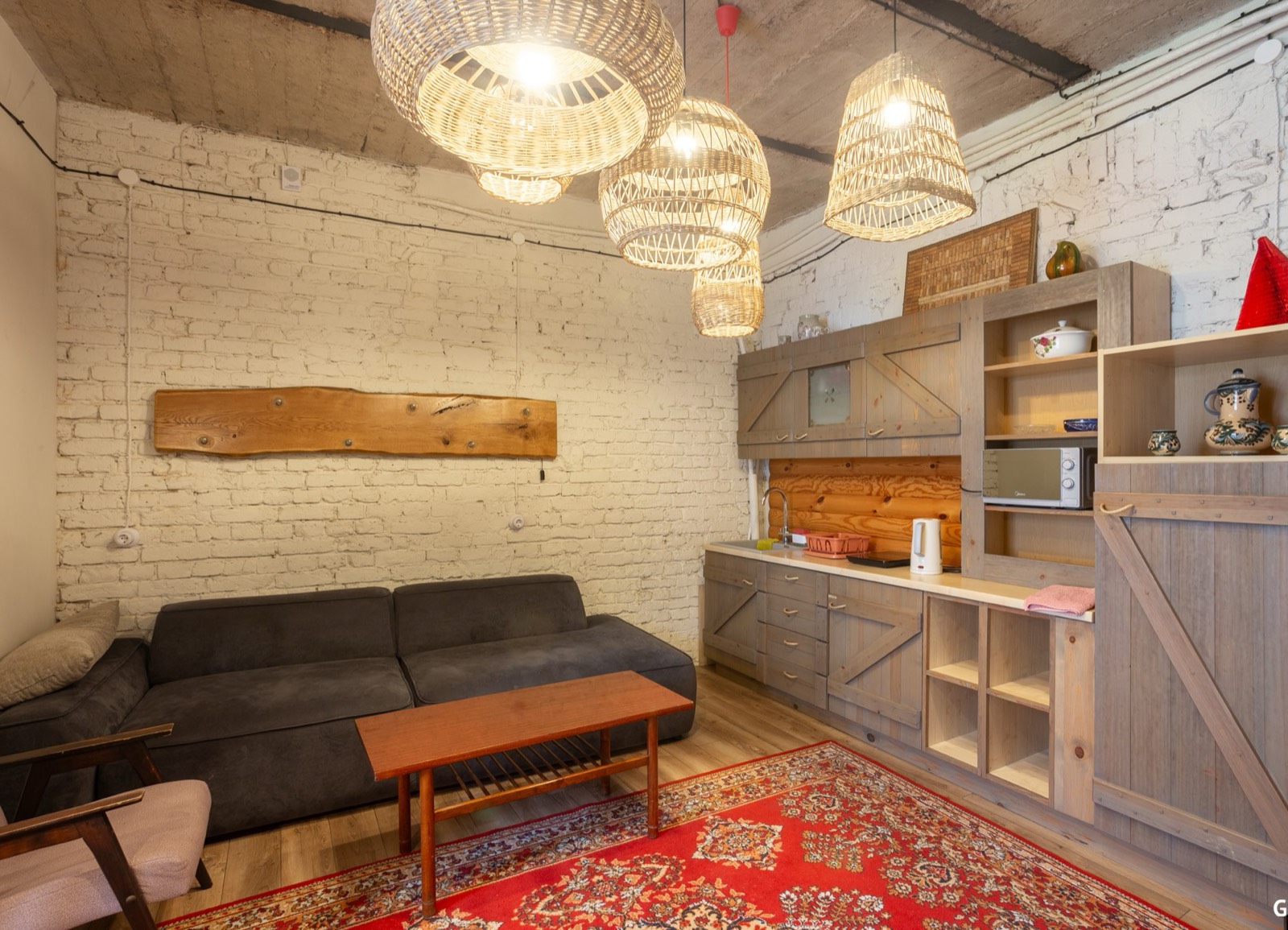
The kitchen and lounge at Gosteam: after a walk to the Neman you can warm up with tea without a café on someone else’s schedule.
From reception to the church it is about a kilometre and a half, roughly twenty minutes. That is longer than to the fire tower, but almost the whole way runs through the historic centre.
Gosteam has whole hotel rooms and hostel beds, a kitchen, Wi‑Fi and closed parking. Pick dates or call +375 33 31 31 312.
Address: 31 Mostovaya Street, Grodno